We Return to Our Strange Life of Stone
Harlow Sculpture Town Residency 2023 https://sculpturetown.uk/
We Return to Our Strange Life of Stone celebrates the
power of community and collaboration in Harlow.
The exhibition showcases the work of the Harlow
residents who took part in stone carving workshops
over the summer.
As part of the 2023 Sculpture Town Residency,
Irena Posner, a graduate from the Royal College
of Art, brought traditional sculpture-making to
Harlow through a community focussed stone
carving project. From April and September, Irena
ran a series of workshops for schools and the local
community offering an introduction to sculpture
and relief carving in Portland stone. The exhibition
showcases the work of the participants.
Alongside the workshops, Irena carved a two-and-
a-half metre Portland stone sculpture
unveiled in HarlowTown Park in November 2023.


The process of making the sculpture on-site was
inspired by Harlow Art Trust’s commission to Mary
Spencer Watson who carved Chiron outside Moot
House in The Stowe in 1953. Spencer Watson was
asked to express the idea of community. She chose
to depict Chiron, a centaur from Greek mythology
who was a teacher of arts. She thought his cave
'was surely an early form of community centre.'


© the artist. Photo credit: Tracy Jenkins / Art UK
SANATORIUM, 2022
Cosmos and
Cosmetics
My mother’s passion for experimental wellness, is something that has occupied her lifestyle and our living room for many years. She is not interested in superficial plastic surgery or aesthetic treatments, she is aiming for immortality.
As a child, I accompanied her on numerous wellness holidays travelling to sanatoriums from Marienbad, Czech Republic to Zaamin, Uzbekistan.
There is a unique flavour to these treatments. It does not conflict with conventional medicine, it is not homeopathy or alternative therapy, but a form of biohacking.
The materials of life extension are predominantly industrial. Treatments include crude oil baths, breathing exercises in salt mines, radon-water douches and electrotherapy. Some early experiments in sanatoriums delivered applicable results. Red light therapy, for example, was adopted by NASA to speed up the healing of wounds in space.

EXPERIMENT 68
Electromagnetic spectrums,
2021
More recently she became interested in practices involving far-infrared radiation. I am older and more inquisitive about her life extension rituals, much to her chagrin.
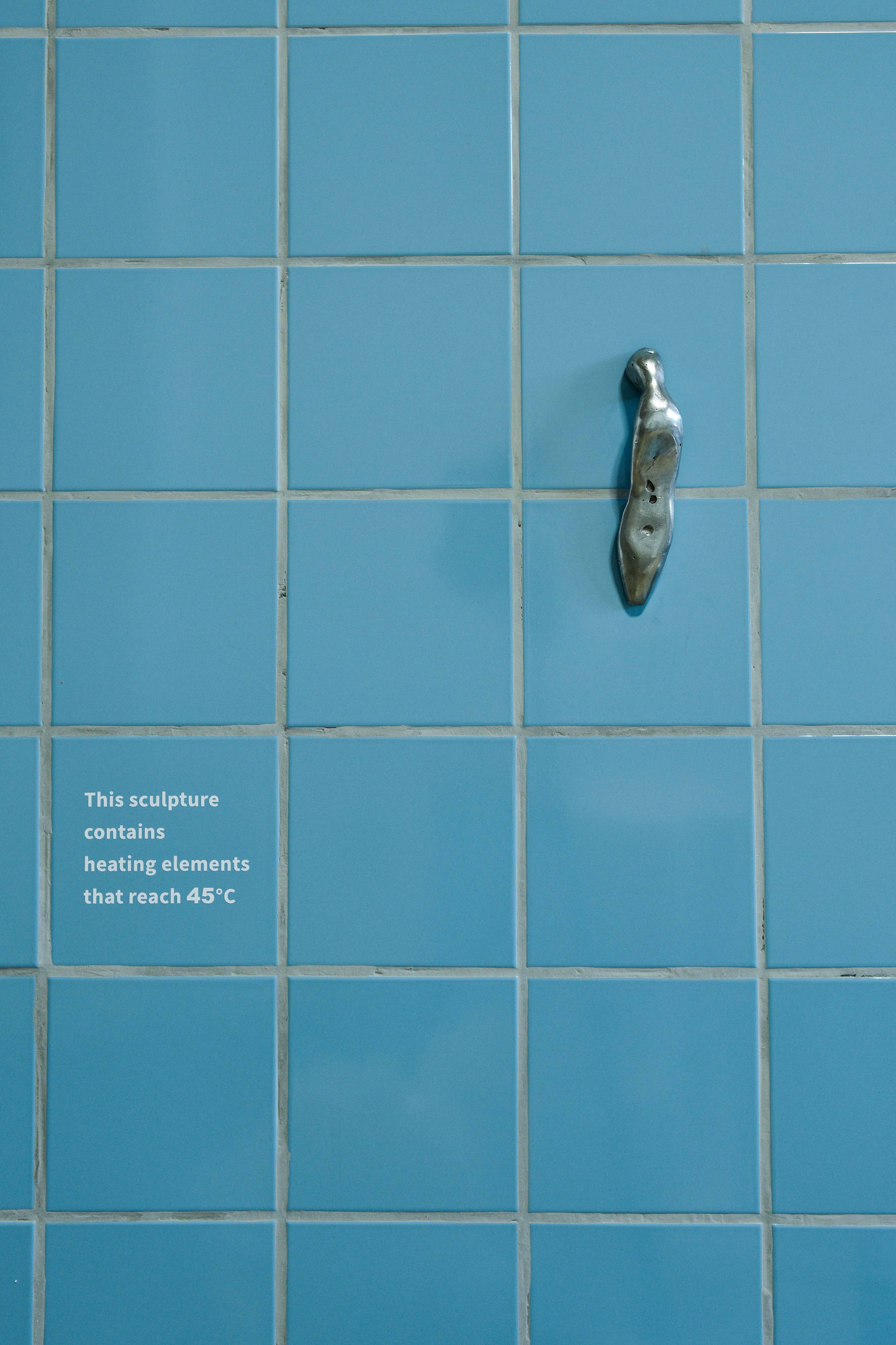
She presents me with large heated ceramic panel holding pride of place in the middle of the living room. The panel is positioned perfectly to deliver a warming glow to the side of her face if she is resting at a comfortable 45 degree angle.
I ask her how this is any different to a radiator. “It is not conventional heat! It is firrrr, like the coat, far-infrared heat, it penetrates the body 4cm.”
She flicks back to the television and resumes watching ‘Emily in Paris.’
“How is it different to a sauna or a heated stone in a spa?” I ask. I can see that she is now definitely annoyed at my line of questioning.
“It’s totally different! Let me call the scientist who helped me build it, he will explain!”
She pauses the programme and dials the scientist. Sure enough, he begins to answer all my questions. He explains to me that far-infrared has a longer wavelength that normal infrared which is too hot and dries the skin and hair. Far-infrared doesn’t heat the air but only the body and nearby objects. The optimal temperature for the heated panel is between 45-50°C. Unlike heated stones in spas and saunas, the heat from the graphene coated ceramic tiles is continuous and runs on a low volt system of only 20V.
This gives me the idea to build heated seats for this installation.
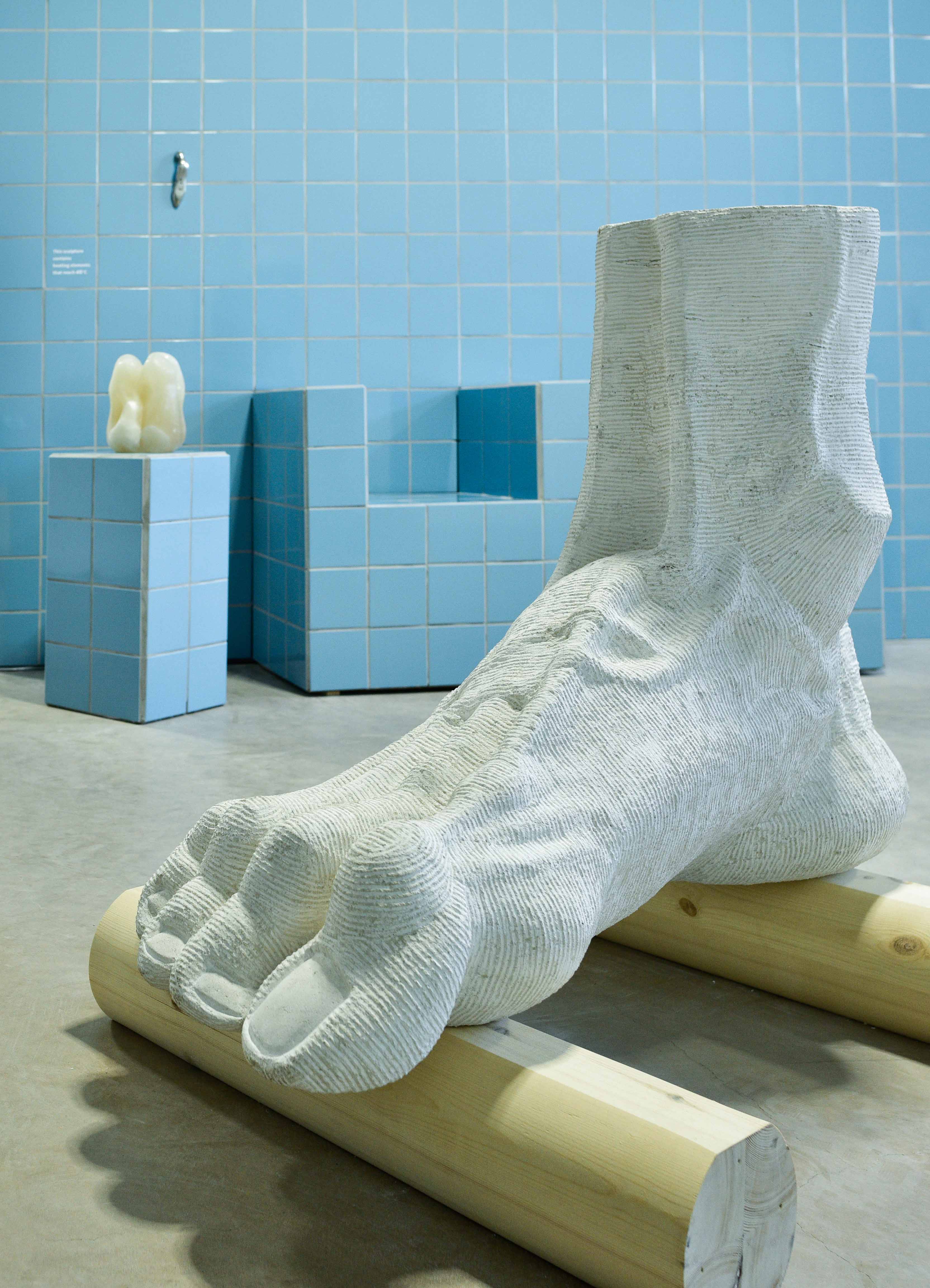
Cross your toes, 2022
120 x 80 x 50 cm
Hand carved Portland stone, pine sleepers
 Sleep
experiment 1, 2022,
45 x 40 x 25cm
Marble and perspex
Cosmism and Cryogenics, 2018
Cosmism promises immortality through materialism and science rather than the anticipation of spiritual salvation. Nikolai Fyodorov, philosopher and author of ‘The Common Task’ believed that the resurrection of the dead is the only way that the builders of the utopia can partake in the society that they helped to build. Fyodorov believed that space travel would be necessary in order to rehouse the resurrected populations.
As Lenin lies in his tomb, at a specially calculated glacial temperature, awaiting resurrection and his first trip to the Moon, my mother is embarking on a cryogenics experiment of her own. This time, we are in a sanatorium specialising in immortality through refrigeration. The blue tiled facility houses a mirror-finished steel drum with a latched door. My mother enters the -140°C cryogenics chamber like an Emperor penguin to Antarctic water.

Sleep experiment 2,
35x42cm, Watercolour on paper
35x42cm, Watercolour on paper

Sleep experiment 3, 35x42cm, Watercolour on paper

Bloodsuckers, 35x42cm, Watercolour on paper
Hirudo, two-minute film, 2020
Old Operating Theatre, London
‘Hirudo’ is a collaborative video installation exploring the ubiquity of quasi-medical aesthetic practices and the fetishisation of cosmetic procedures. The resulting work, a self-styled commercial and enquiry into spectacle and narcissism: the tangibility of achieving physical improvements and the antithetical fragility of flesh in response to invasive treatments.
The project was part of a site-specific installation at The Old Operating Theatre, one of the oldest surviving medical theatres in London where leeches were widely used for reconstructive surgery and blood-letting, a practice believed to purify the blood and prevent illness. Today, the use of medical grade leeches is predominantly reserved for to the field of aesthetics and alternative therapy.

Hirudo, 2020,
Still from HD Video 2.33mins

Making Marks
Battersea Park, September 2022
As my canine companion readies himself for a quick leg cock on Barbara Hepworth’s Single Form in Battersea Park I begin to understand that no one interacts better with outdoor sculpture than man’s best friend. The absence of the sculpture will perhaps be mostly felt by my four legged friend to whom the sculpture represents a navigation point and an indication of their territory.
Dogs mark at strategic locations to communicate social status, ownership, to attract females or to warn off competitors.
The Hepworth sculpture from this stakeholder’s perspective represents an important strategic site. We think that it is important touphold this site whilst the sculpture is in transit and install something that would be similarly appealing to the furry friends of Battersea Park. We plan to conduct research to establish the types of materials and surfaces that dogs enjoy scent marking and
create a multi-sensory functional sculpture to enable dogs to continue their daily pilgrimage whilst Single Form is on loan.


Barbara Hepworth’s Single Form at the Rijksmuseum Gardens, 2022
Starting from Barbara Hepworth’s ideas of utopian, spiritual and metaphysical relationships of the human and nature, for our proposal we wanted to bring things down to earth and into the daily life of Battersea Park. Hepworth's work might be read as a concern for relationships; Kgure and landscape, colour and form, individual and society. With this work we explore the relationships between art and animals. Grounded in a more-than human awareness, the work takes into consideration the needs and experiences of other life forms i.e dogs sharing the park and enjoying the sculpture as part of their sacred daily rituals.
left: proposal sketch


Fable Tree, 2021
280 x 180 x 180cm
Portland stone, steel
Thatcham, Newbury, England
Fable Tree is a site specific installation constructed from steel and limestone. The work was conceived as a memorial piece for a private residence in Thatcham, Newbury. It was executed with the help and support of Portland Stone and Quarry Trust in 2021.
The idea for the work centred on the ontology of human relationships through considerations of objects’ position in space, size and weight. Within the work is a conversation. The oval shapes suggest liminality, encapsulation or ostensibly the ovoid of a head. It is a statement of beginnings and the generative potential of forms. The choice of stone, a whitbed Portland stone, was dictated by its fleshy texture and close porosity, absorbing light and casting diffuse shadows. The stone triad balance on a russet steel structure, a construction that keeps them in suspense; by night the frame disappears and they float.


